
In the digital age, data is being generated every second—from social media interactions to online purchases and website visits. However, raw data alone has little value unless it is properly understood and used. This is where analytics plays a crucial role. Analytics helps convert raw data into meaningful insights that guide better decision-making.
In 2026, analytics is no longer limited to large corporations. Small businesses, students, marketers, and even content creators are using analytics to improve performance and achieve their goals. This guide will help beginners understand analytics in a simple and practical way.
What is Analytics?
Analytics is the process of collecting, organizing, analyzing, and interpreting data to discover useful information and support decision-making.
In simple terms, analytics answers questions like:
- What is happening?
- Why is it happening?
- What will happen next?
- What should be done?
For example, if a website owner notices a drop in traffic, analytics tools can help identify the cause, such as slow loading speed or low-quality content. Based on these insights, improvements can be made.
Why Analytics is Important
Analytics is important because it helps individuals and businesses make informed decisions instead of relying on guesswork. In a competitive environment, data-driven decisions often lead to better outcomes.
Some key advantages of analytics include:
- Improved decision-making based on real data
- Better understanding of customer behavior
- Increased efficiency and productivity
- Identification of trends and opportunities
- Reduction in risks and unnecessary costs
Organizations that use analytics effectively can adapt quickly to market changes and stay ahead of competitors.
Types of Analytics
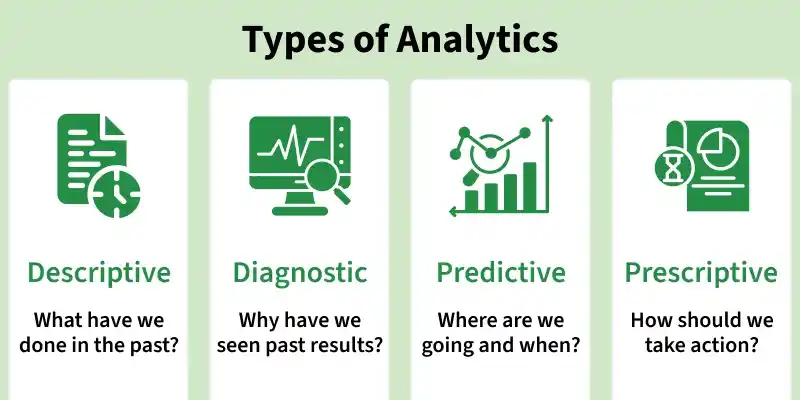
Analytics is generally divided into four main types, each serving a different purpose.
| Type of Analytics | Description | Example |
|---|---|---|
| Descriptive Analytics | Explains what has already happened | Monthly sales report |
| Diagnostic Analytics | Explains why something happened | Analyzing reasons for sales drop |
| Predictive Analytics | Predicts future outcomes using data | Forecasting future sales |
| Prescriptive Analytics | Suggests actions to achieve desired results | Recommending marketing strategies |
Each type builds on the previous one, moving from understanding past data to making future decisions.
How Analytics Works
The analytics process follows a structured approach. Understanding this process helps beginners learn analytics more effectively.
First, data is collected from various sources such as websites, mobile apps, customer databases, and social media platforms. This data can be structured (organized) or unstructured (raw and complex).
Next, the collected data is cleaned and processed. This step is important because incorrect or duplicate data can lead to wrong conclusions.
After processing, the data is analyzed using different tools and techniques. Analysts look for patterns, trends, and relationships within the data.
Finally, the results are presented through charts, graphs, and dashboards, making it easier to understand. These insights are then used to make informed decisions.
Popular Analytics Tools in 2026
There are many tools available that make analytics easier, even for beginners. Some of the most commonly used tools include:
- Google Analytics for tracking website performance
- Microsoft Power BI for creating dashboards and reports
- Tableau for advanced data visualization
- Microsoft Excel for basic data analysis
- Python and R for advanced analytics and machine learning
Choosing the right tool depends on your goals and skill level. Beginners usually start with Excel or Google Analytics before moving to advanced tools.
Applications of Analytics
Analytics is widely used across different industries. In digital marketing, it helps track user behavior, measure campaign performance, and improve return on investment. In e-commerce, analytics is used to understand customer preferences, optimize pricing, and recommend products.
In healthcare, analytics helps in predicting diseases and improving patient care. In finance, it is used for risk assessment and fraud detection. Even in education, analytics is used to monitor student performance and improve learning outcomes.
This wide range of applications shows how important analytics has become in modern life.
Skills Required to Learn Analytics
To start learning analytics, you do not need advanced technical knowledge. However, certain skills can make the learning process easier.
Basic skills include understanding data, logical thinking, and problem-solving ability. A basic knowledge of statistics is also helpful.
On the technical side, familiarity with tools like Excel and SQL is important. As you progress, you can learn advanced skills such as programming languages (Python or R) and data visualization tools.
Consistency and practice are key to mastering analytics.
Career Opportunities in Analytics
Analytics has become one of the most in-demand career fields in 2026. Companies across all industries are looking for professionals who can analyze data and provide actionable insights.
Some popular career options include:
- Data Analyst
- Business Analyst
- Data Scientist
- Marketing Analyst
- Financial Analyst
In India, entry-level professionals can earn between ₹3 to ₹6 LPA, while experienced professionals can earn ₹10 LPA or more, depending on their skills and experience.
Future of Analytics
The future of analytics is strongly connected with emerging technologies like Artificial Intelligence and Machine Learning. These technologies are making analytics faster, smarter, and more accurate.
Key trends shaping the future include automation of data analysis, real-time insights, and increased use of predictive analytics. Businesses are increasingly relying on analytics to make quick and effective decisions.
As data continues to grow, the demand for analytics professionals will also increase significantly.
Conclusion
Analytics is a powerful tool that helps turn data into meaningful insights. It is essential for making better decisions, improving performance, and achieving growth in today’s data-driven world.
For beginners, the best approach is to start with the basics, learn simple tools, and gradually build advanced skills. With consistent learning and practice, anyone can develop expertise in analytics and unlock new career opportunities.
FAQs
1. What is analytics in simple terms?
Analytics is the process of analyzing data to find useful insights and support decision-making.
2. Can beginners learn analytics easily?
Yes, beginners can start with basic tools like Excel and gradually learn advanced concepts.
3. What are the main types of analytics?
Descriptive, Diagnostic, Predictive, and Prescriptive analytics.
4. Which tool should I learn first?
Excel and Google Analytics are the best tools for beginners.
5. Is analytics a good career option in 2026?
Yes, analytics is a highly in-demand and well-paying career field.
- Best Food Creators to Follow in 2026: Reviews, Recipes & Trends

- Best Lifestyle Influencers in 2026: Top Creators to Follow

- Best Business Analytics Strategies for Data-Driven Growth in 2026

- Best Content Marketing Strategies in 2026 for Business Growth

- Most Popular Lifestyle Influencers to Follow in 2026